
Child care
The payor funds 88 cents of every dollar of child care, on money the order has already moved to the other parent
Massachusetts allocates child care in proportion to income, but the Worksheet measures that proportion before the base support order moves a single dollar between the two households, and never measures it again. At the worked example, that funds 88 cents of every dollar of the recipient's $15,600-a-year child care claim.
Of every dollar of the recipient's $15,600-a-year child care claim, funded by the payor at the worked example, on an income share measured before the order moves any money
Verified against the form's own calculation scripts
The worked example on this page runs three children, a $300-a-week child care claim paid by the recipient, and the two incomes the Worksheet requires. They are Worksheet figures from a real Massachusetts case, and neither is either parent's current income. I pay child support in Massachusetts myself, so I have a stake in the outcome; a reader should be able to check whether the arithmetic changes when the numbers move. It doesn't: the same allocation gap holds across income levels and child counts as well as at this example's figures.
The model behind every number on this page is model/childcare_post_transfer.py, checked by its test suite against model/worksheet.py, with the printed run behind the table below.
The child care split uses income shares measured before the base order moved any money between the households
Line 3c is each parent’s share of combined available income, computed before the base support amount at Line 7d exists. Line 6a is the child care one parent actually pays. Line 6b multiplies the other parent’s Line 3c share by that amount. So when the recipient pays the provider, the payor is charged his own Line 3c share of the recipient’s cost.
By the time child care is added at Line 6, the base order has already moved a large share of the payor’s income to the recipient’s household. Line 6b never re-measures the shares against that transfer.
The payor’s share falls from 88 cents to 53 cents once the split is measured after the order and after tax
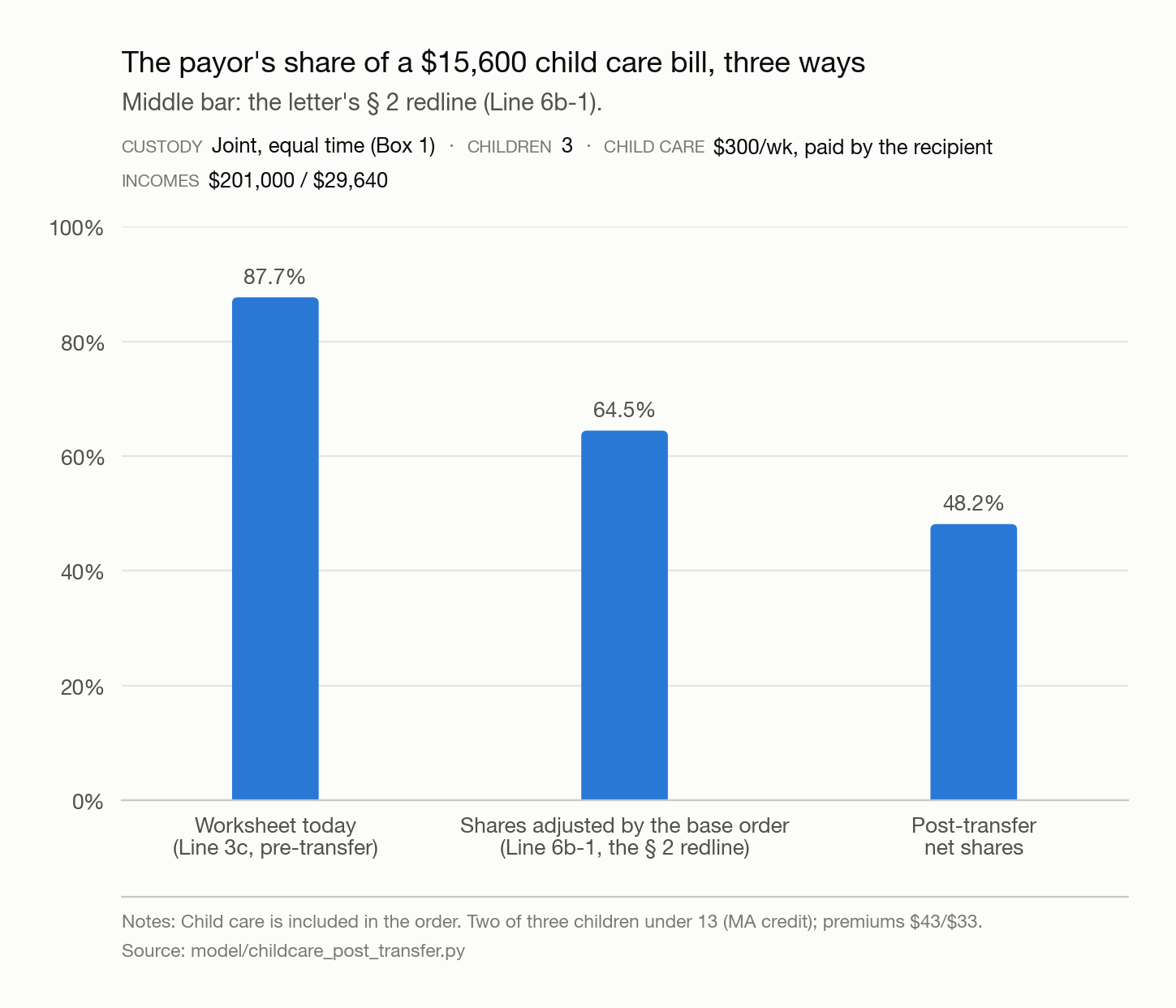
The payor's share of a $15,600 child care bill, three ways to split it.
Line 3c allocates 87.7 percent to the payor on pre-transfer income shares.
The § 2 fallback this project's comments to the Trial Court propose, adjusting shares by the base order alone (Line 6b-2), gives 64.5 percent. The § 2 primary redline, measured net of tax on a withholding basis (Line 6b-1), gives 53.0 percent.
Source: model/charts/fig2_childcare.py ·
data (CSV)
How big the claim is matters as much as how it is split. This page’s $300-a-week claim works out to $100 a week per child, the level the federal-law finding examines. At that level, 40% of three-child income pairs on a model grid already have an order that takes more than half of take-home pay under primary custody, and some cross that mark at joint custody too. 10.6% cross 60 percent, the federal limit on what can be withheld from wages. That is child support higher than federal law lets the state collect from wages, and the excess is still owed.
Splitting child care before the order overcharges the payor more with each child, whichever parent pays the provider
The same gap — the split before the order moves money, versus after — shows up whichever parent pays the provider. Three exhibits below hold the arrangement fixed at $100 a week per child and vary only the number of children.
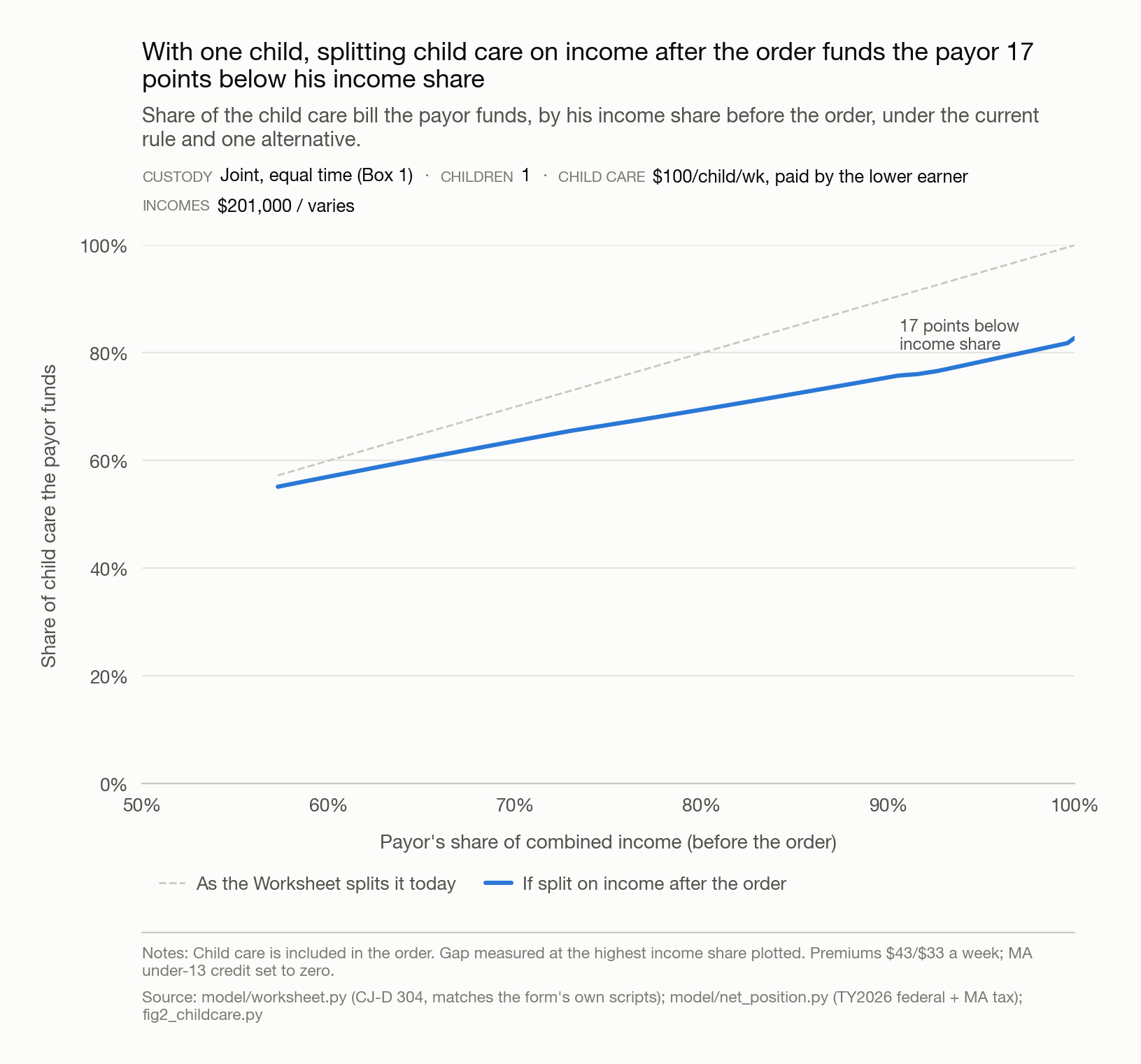
With one child, splitting child care on income after the order funds the payor 17 points below the payor's income share.
Share of the child care bill the payor funds against the payor's income share before the order (Line 3c), one child, $100 a week paid by the lower earner, under the current rule and one alternative.
The gap is measured at the highest income share plotted.
Source: model/charts/fig2_childcare.py ·
data (CSV)
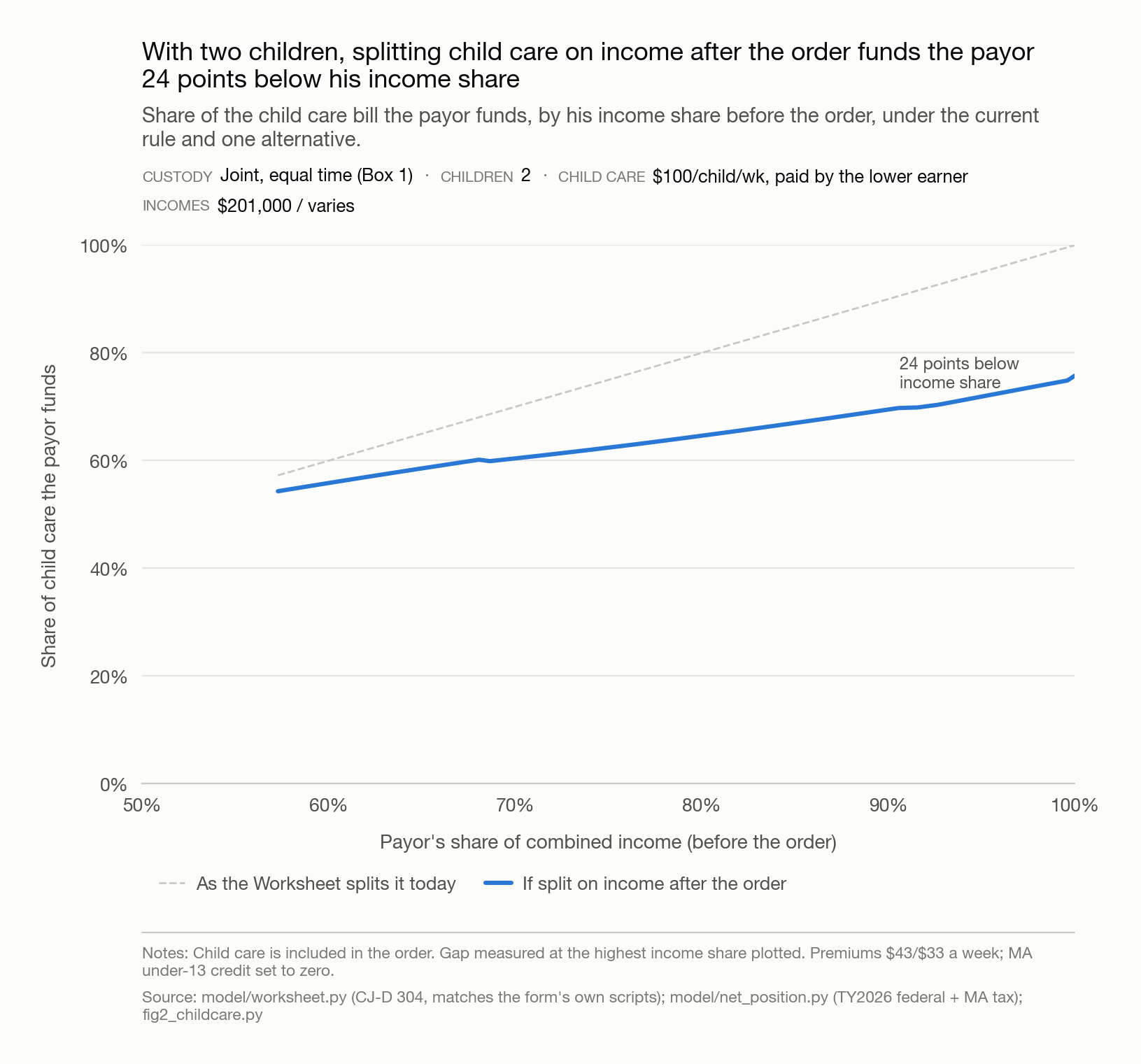
With two children, splitting child care on income after the order funds the payor 24 points below the payor's income share.
Same construction as the one-child exhibit, two children.
The gap widens with the number of children.
Source: model/charts/fig2_childcare.py ·
data (CSV)
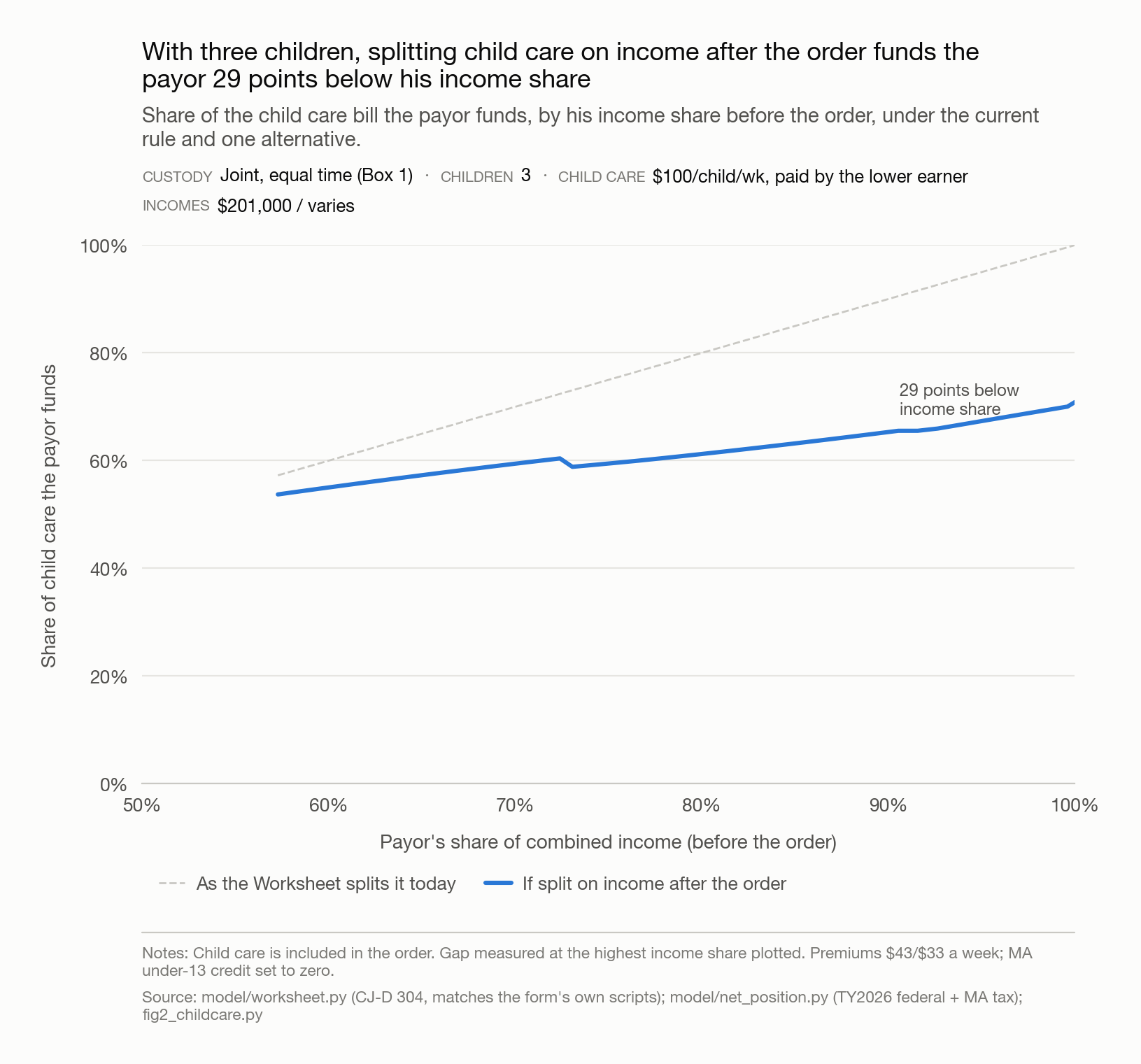
With three children, splitting child care on income after the order funds the payor 29 points below the payor's income share.
Same construction as the one- and two-child exhibits, three children, the worked example's own child count.
This is the worked example's own child count.
Source: model/charts/fig2_childcare.py ·
data (CSV)
When both parents pay for care, the payor still bears more of it than the payor’s income share
The same mechanism runs in the other direction, too, when both parents pay for care during their own parenting time.
Put the two bills side by side, for the same family and the same $300 a week. When the recipient pays it, the order rises from $1,012.73 to $1,275.77 a week. When the payor pays the same amount during the payor’s own time, $15,600 a year, the order comes down by $270 a year. The Worksheet charges the payor for the other parent’s child care and gives almost no relief for the payor’s own.
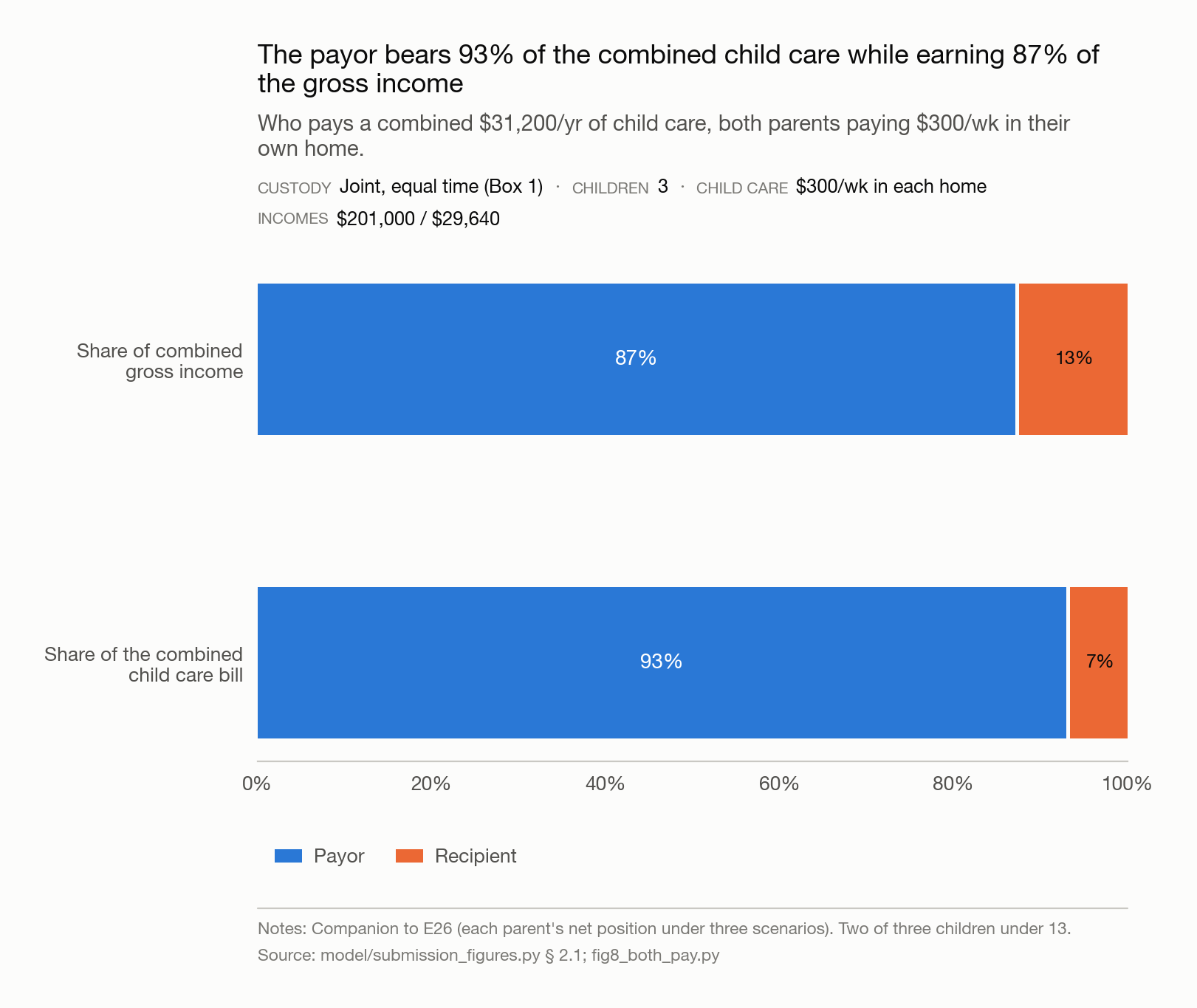
The payor bears 93 percent of the combined child care while earning 87 percent of the gross income.
Each parent pays $300 a week during their own parenting time, the ordinary case at equal time.
Two stacked bars: share of combined gross income and share of the combined $31,200 child care bill.
Source: model/charts/fig8_both_pay.py ·
data (CSV)
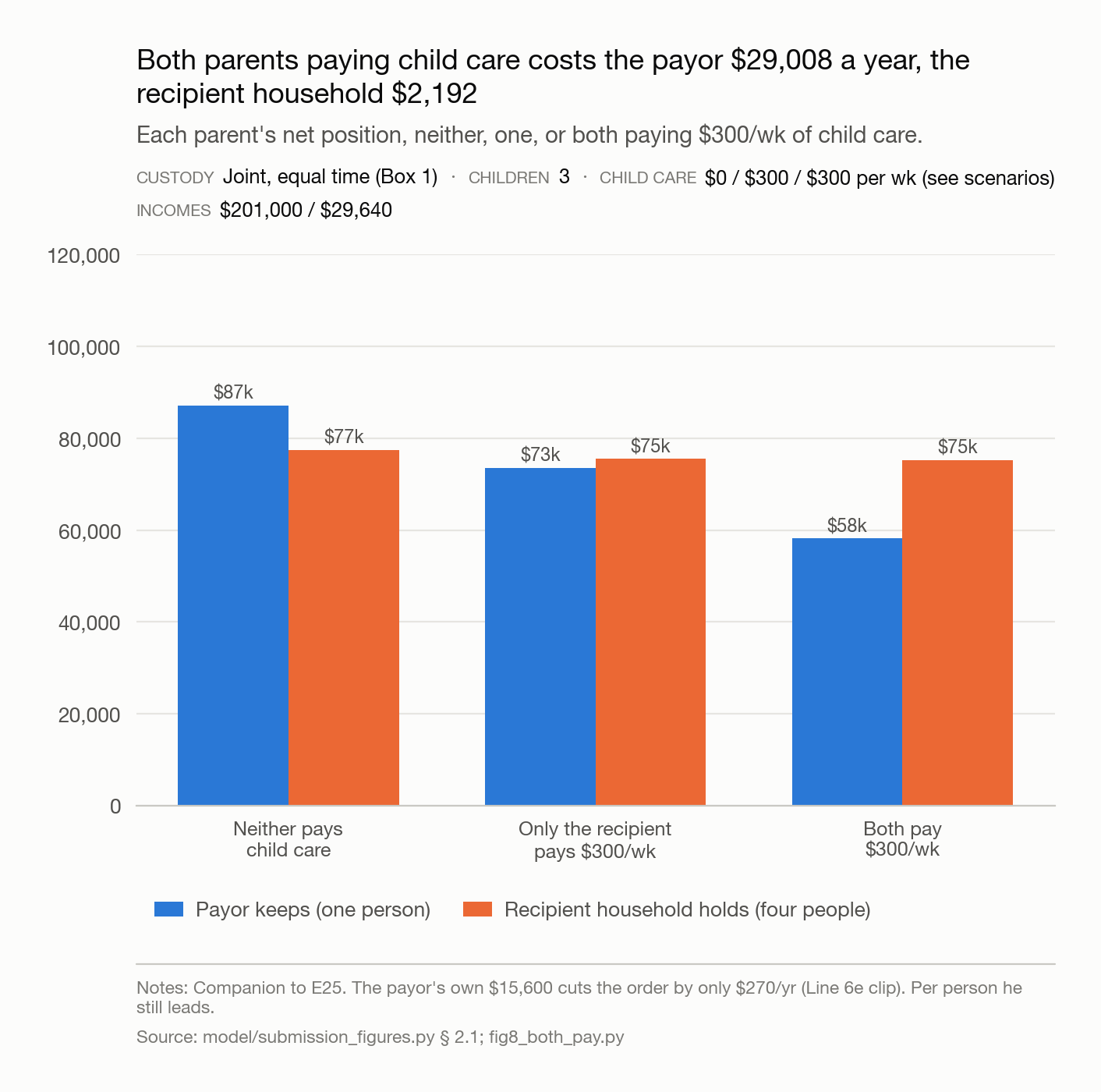
Both parents paying child care costs the payor $29,008 a year, the recipient household $2,192.
Each parent's net position under three scenarios: neither pays, only the recipient pays $300 a week, both pay $300 a week.
The Worksheet allocates the recipient's cost to the payor through Line 6b and passes the payor's own cost back through Line 6e at about two cents on the dollar, so that $15,600 reduces the order by only $270 a year. Order plus the payor's own child care reaches 58.4 percent of net income while Line 7e reads 33 percent. Per person the payor still leads.
Source: model/charts/fig8_both_pay.py ·
data (CSV)
Method: the full split table, four ways to measure the same $15,600 bill
| Basis for the split | Payor’s share | Payor funds |
|---|---|---|
| Line 3c, pre-transfer (what the form does today) | 87.7% | $13,678/yr (order rises to $1,276/wk) |
| Shares adjusted by the base order (fallback redline at Line 6b-2, without a net computation) | 64.5% | $10,054/yr (order $1,206/wk, $3,624/yr less than today) |
| Post-transfer net shares, withholding basis (the redline proposed, Line 6b-1; order $1,172/wk, $5,415/yr less than today) | 53.0% | $8,263/yr |
| Post-transfer net shares counting refundable tax credits, alternating-year Child Tax Credit convention (analysis only, not proposed) | 49.7% | $7,754/yr |
(Source: model/runs/childcare-post-transfer-run-2026-09-08.txt, printed by
model/childcare_post_transfer.py (the 2026-09-05 run predates rule 5, the withholding-basis
figure this table quotes, and is kept alongside for the record); the order figures are from
model/runs/submission-figures-run-2026-09-09.txt.) Exhibits E25 and E26 above show the same
mechanism when both parents pay for care: Line 6e limits how much of the payor’s own claim can be
recovered once the payor’s income share crosses outside the low-income protection the line was written for.
The calculator on the home page reports the same 53.0 percent. Unlike the figures that count the refundable credits, this one does not depend on the children’s ages, so the site and the comments print one number, not two.
This is one worked example, and per person the payor still holds more even when both parents share the cost
Allocating child care in proportion to income is a defensible rule, and the objection is to which income the proportion is measured against. $300 a week is a real but not extreme claim relative to the $430-per-child statutory ceiling, and a smaller claim moves the split by less, a larger one by more. This is one worked example, and how far a typical claim sits from it is not known from anything in this repository.
Per person, the payor remains ahead. Even in the scenario where both parents pay for care and the payor is charged 93 percent of the combined bill, the payor still holds $58,163 after tax against $18,801 after tax each for the recipient's household of four.
Check it yourself
model/childcare_post_transfer.pyComputes all four allocation rules: before the order, after the order on gross adjusted by the base order, after the order net on a withholding basis, and after the order net counting refundable credits.- Its test suite Pins the 87.7%, 64.5%, 53.0%, 49.7%, and resulting order figures quoted above.
model/worksheet.pyandmodel/test_worksheet.pyThe Line 6a/6b/6e implementation, including the test that the payor bears roughly 93 percent of combined child care when both parents pay for it under equal shared parenting.- The printed runs Behind every figure above, alongside the base-order run.