
Nine problems with the Massachusetts child support guidelines, and the first is federal law’s ability-to-pay rule
The figures below (88 cents, 6.9%, 57%, 48%) come from the worked example used throughout this site: three children, the payor's income and the other parent's income entered as the Worksheet requires. They are Worksheet figures from a real Massachusetts case, and neither is either parent's current income. I pay child support in Massachusetts myself, so I have a stake in the outcome. Each finding page shows the same gap holding across a range of incomes as well as at this example's figures.
Every number traces to model/worksheet.py, checked by model/test_worksheet.py against the form's own calculation scripts. More on About.
Each one traces to a script in this repository, or, for the seventh, to the guidelines’ own text on deviation. Biggest first.
1. Federal law requires child support to be based on what a parent can actually pay
Every income pair run through the Worksheet's own arithmetic
While federal law requires every order to rest on the parent’s ability to pay, the Worksheet never checks the presumptive amount against what a parent actually has left after tax. With child care claimed, it can set child support higher than federal law lets the state collect from wages. The excess is still owed. No court or federal agency has ruled on whether the guidelines meet this standard. Federal approval of the state’s plan has not addressed it.
Federal rules require a state’s guidelines to base the order on the parent’s “earnings, income, and other evidence of ability to pay,” 45 C.F.R. § 302.56(c)(1), and the Massachusetts Guidelines recite that standard. The Worksheet has no line for tax or take-home pay. At $100 a week of child care claimed per child, three children and primary custody, 40% of income pairs on a model grid have an order that takes more than half of take-home pay, and 10.6% cross 60 percent, the federal limit on what can be withheld from wages, 15 U.S.C. § 1673(b)(2). The hardship test does flag those orders, but it lowers nothing unless the parent raises it and a judge agrees. With no child care claimed, none do.
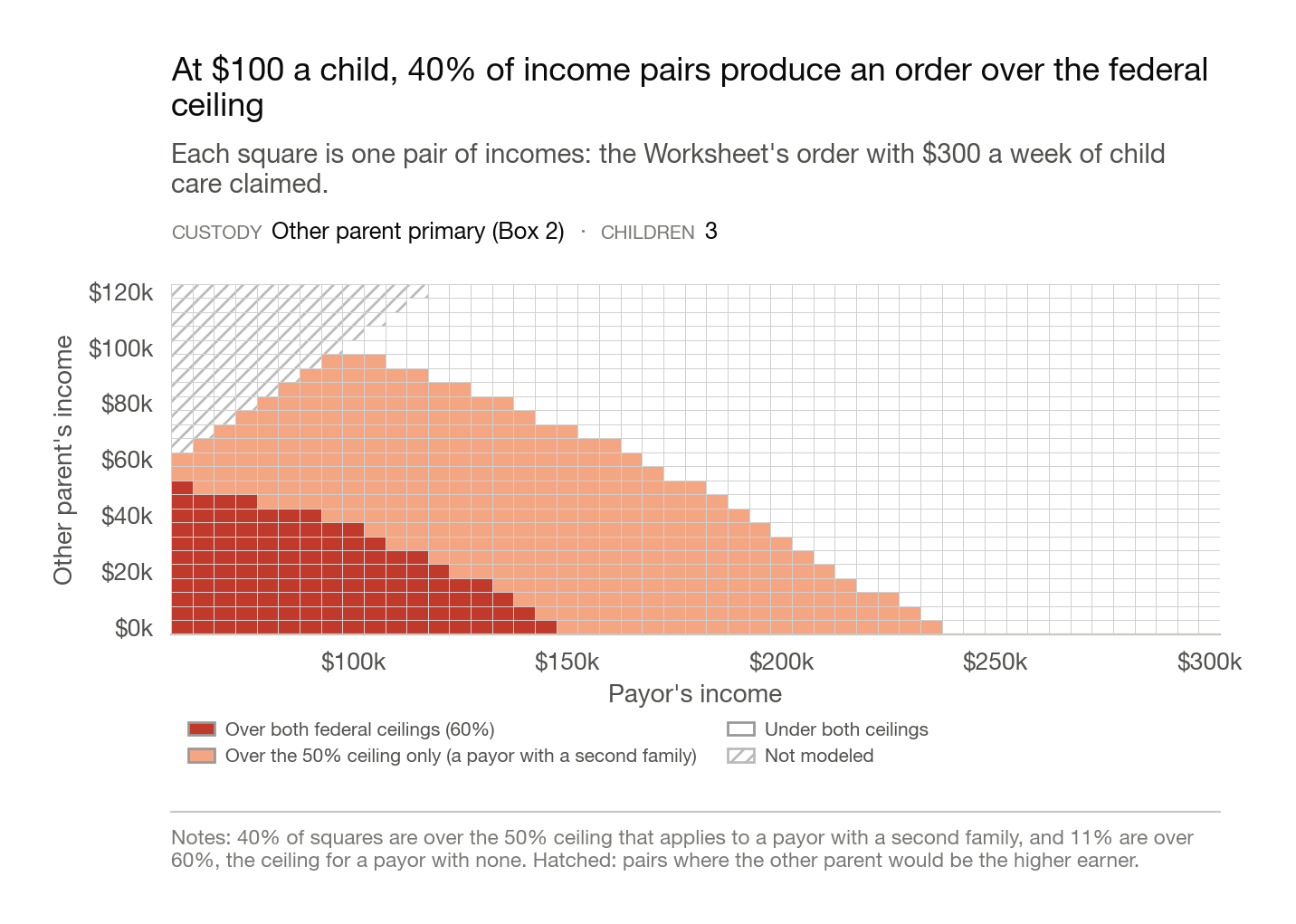
At $100 a child, 10.6% of income pairs produce an order over the federal limit on wage withholding.
Each square is one pair of incomes: the Worksheet's order with $300 a week of child care claimed for three children, primary custody.
Dark squares are over the federal limit on wage withholding, 60 percent of take-home pay. Light squares are over half of take-home pay but under that limit. Hatched squares are pairs where the other parent would be the higher earner. 10.6 percent of squares are dark. All of them also trip Massachusetts's own 40 percent hardship presumption, which helps only if the parent raises it and a judge agrees.
Source: model/ccpa_grid.py ·
data (CSV)
2. The payor funds 88 cents of every dollar of child care, on money the order has already moved to the other parent
Verified against the form's own calculation scripts
Line 6b splits a child care claim by each parent’s Line 3c income share, computed before Line 7d’s base support order moves any money between the households, and never revisits the split afterward.
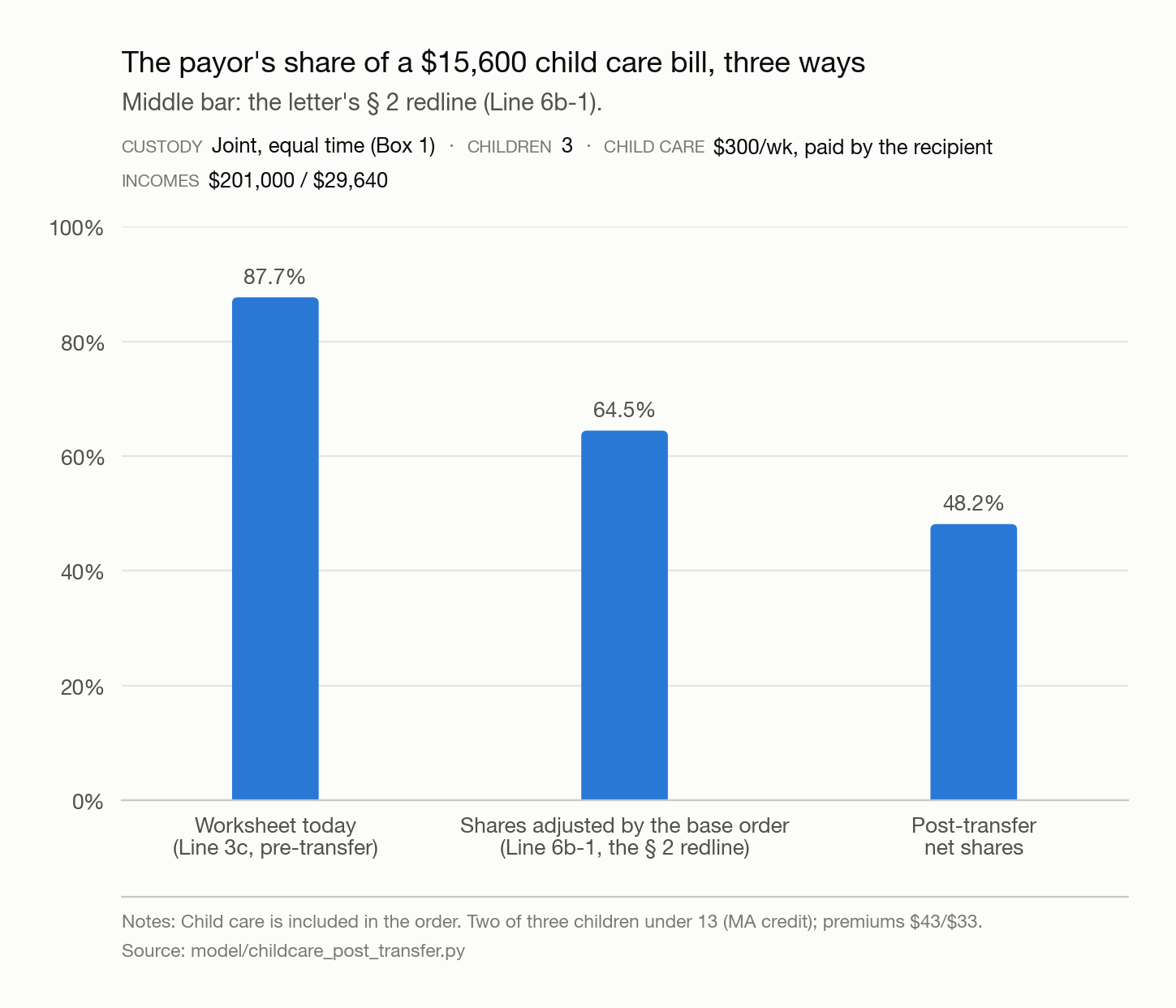
The payor's share of a $15,600 child care bill, three ways to split it.
Line 3c allocates 87.7 percent to the payor on pre-transfer income shares.
Adjusting the shares by the base order alone, the fallback confined to the Worksheet's existing gross-based lines (Line 6b-2), gives 64.5 percent. The letter's current § 2 redline, measured net of tax on a withholding basis (Line 6b-1), gives 53.0 percent.
Source: model/charts/fig2_childcare.py ·
data (CSV)
3. Splitting the children’s time equally cuts the order by 6.9%. Utah cuts it by 55%, Montana and Hawaii by 52%
Verified against the form's own calculation scripts
Taking the children half the nights instead of a third of them is worth 6.9% off the order. At the same two incomes, the states that give the largest reductions give more than half.
Line 6g nets the two parents’ Line 6e amounts, which reduce to the gap between their income shares once Box 1 (equal parenting time) puts zero children in the payor’s column; no line measures overnights. That gap shrinks the discount from 77.6 percent at a narrower income share to 6.9 percent at this family’s. Research on custody decided mainly by a financial incentive finds children can fare worse under it (Fernández-Kranz, Roff and Sun, Journal of Economic Behavior & Organization 189 (2021)), an argument against pricing parenting time by formula in either direction, whether a credit shrinks or grows. The recommendations page’s proposal for a larger credit is not exempt from that caution.
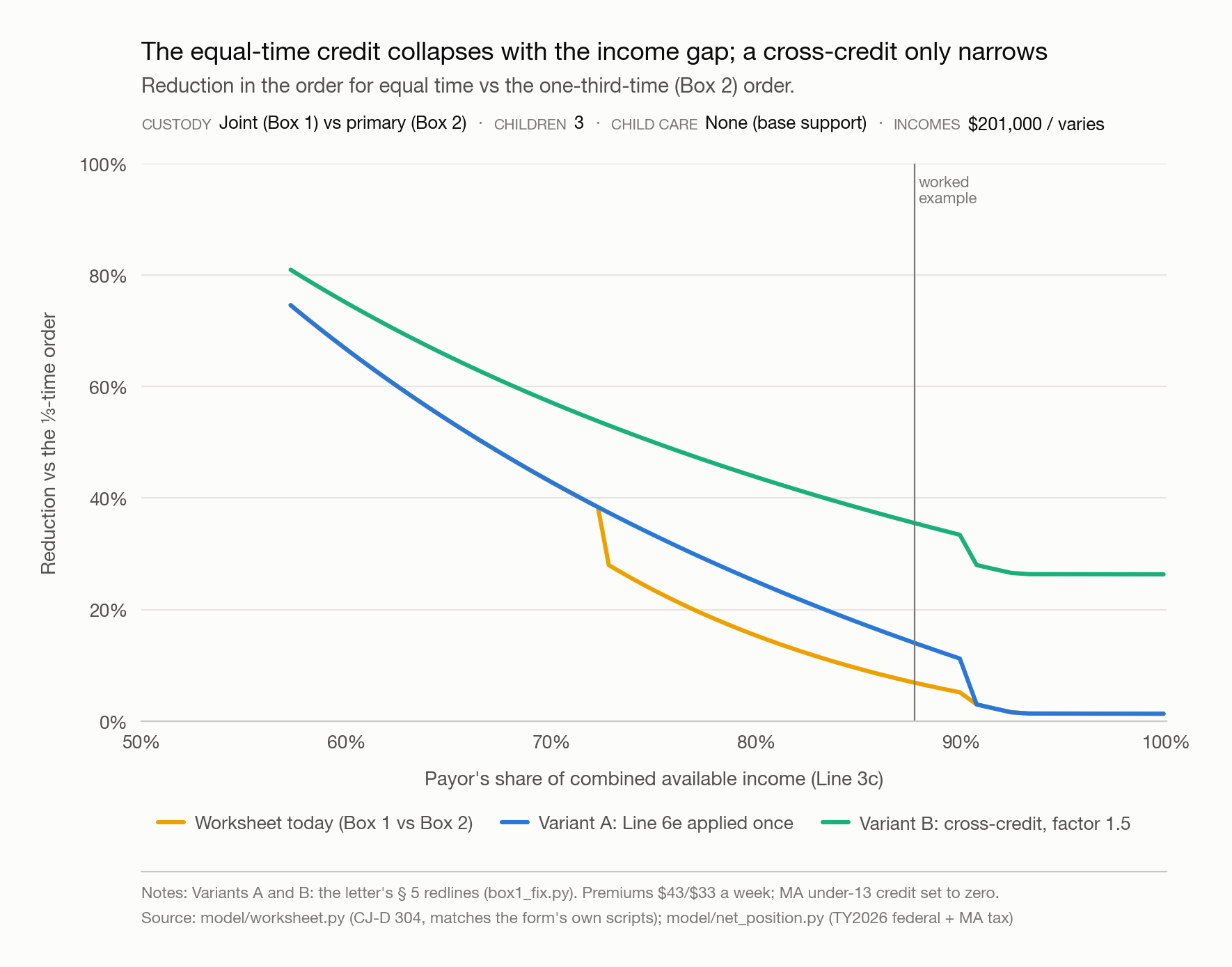
The Worksheet's equal-time credit collapses as the income gap widens.
The discount for equal time, against the primary-custody order, falls from about 75 percent at a 57 percent payor income share to 7 percent at 88 percent and 1 percent at 96 percent, because no parenting-time quantity enters any line.
Variant A, applying Line 6e once, raises the discount to 14.0 percent. Variant B, the cross-credit design 18 states and DC use at a 1.5 duplication factor, raises it to 35.5 percent and stops it collapsing.
Source: model/box1_fix.py · model/charts/fig3_credit.py ·
data (CSV)
Read the full finding → · The formula most states use instead →
4. Massachusetts charges more for joint custody than 47 states charge when the recipient has primary custody
One set of incomes, fifty states. How each state was checked
Massachusetts orders more under equal parenting time than any of the fifty states modeled, and more under primary custody than every one of them but Hawaii. Its joint-custody order is higher than the primary-custody order in 47 states. Only Hawaii and Wisconsin’s primary-custody orders are higher than Massachusetts’s joint-custody order. Georgia is held out: its enacted formula orders less at equal time than at primary custody.
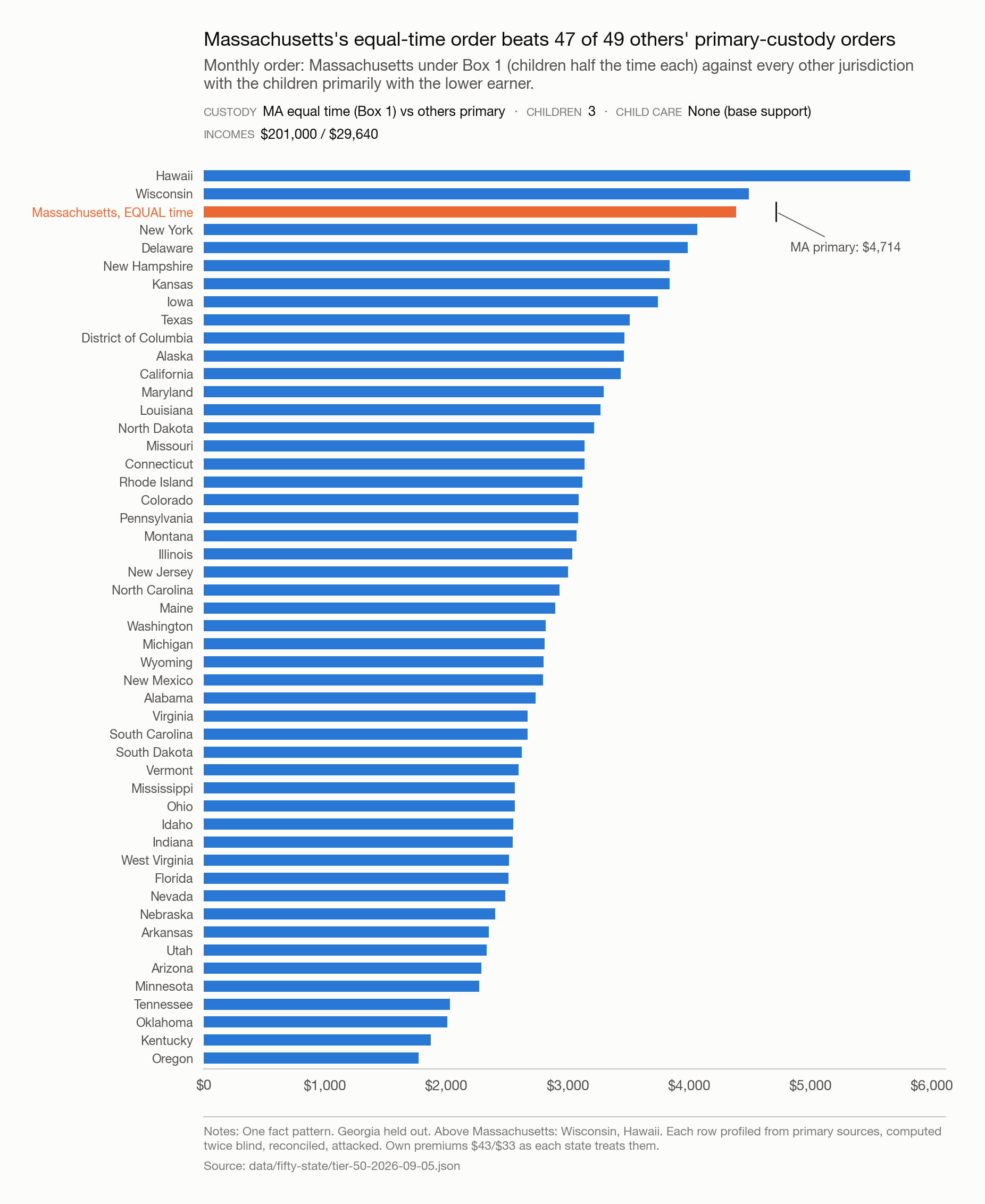
At primary custody, only Wisconsin and Hawaii order more than Massachusetts does at equal time.
Monthly order: Massachusetts at equal time against every other state with the children primarily with the lower earner. Georgia held out.
Fifty of fifty-one jurisdictions passed every check; Georgia is held out because its enacted formula produces a lower order under primary custody than under equal time, which the state's own calculator reproduces. Each state's amount comes from its own guidelines, worked out twice and checked for errors. Own premiums ($43/$33) as each state treats them. One worked example; the ranking generalizes to nothing else.
Source: model/charts/fig10_ma_shared_vs_primary.py ·
data (CSV)
Read the full finding → · Why cost of living does not explain it →
5. The hardship test measures gross income when it should measure net
Verified against the form's own calculation scripts
The hardship presumption is supposed to fire at 40% of the payor’s income. It does not fire until the order takes 57% of the payor’s net pay.
Section IV.C calls an order at 40% of income a presumptive hardship, and Line 7e is the box on the Worksheet that tests for it. But Line 7e divides by Line 3a, which is gross income less health premiums and any other support orders and carries no tax adjustment at all, while the order is paid out of net. The test is in gross, the payment is in net, and the gap between them widens as the payor’s tax rate rises. At the worked example that gap is 17 points.
6. The payor keeps less than half of every extra dollar earned
Verified against the form's own calculation scripts
At $201,000, of the next $10,000 the payor earns, 20.3% goes to the order and 31.3% to income and payroll tax. The payor keeps 48.3%. The order’s share of a raise is roughly double Table A’s own 10% top bracket, because the child-count multiplier and the payor’s rising income share both scale up with income. Across $150,000 to $300,000 of payor income the share kept stays between 39% and 48%, so the effect is not particular to this example.
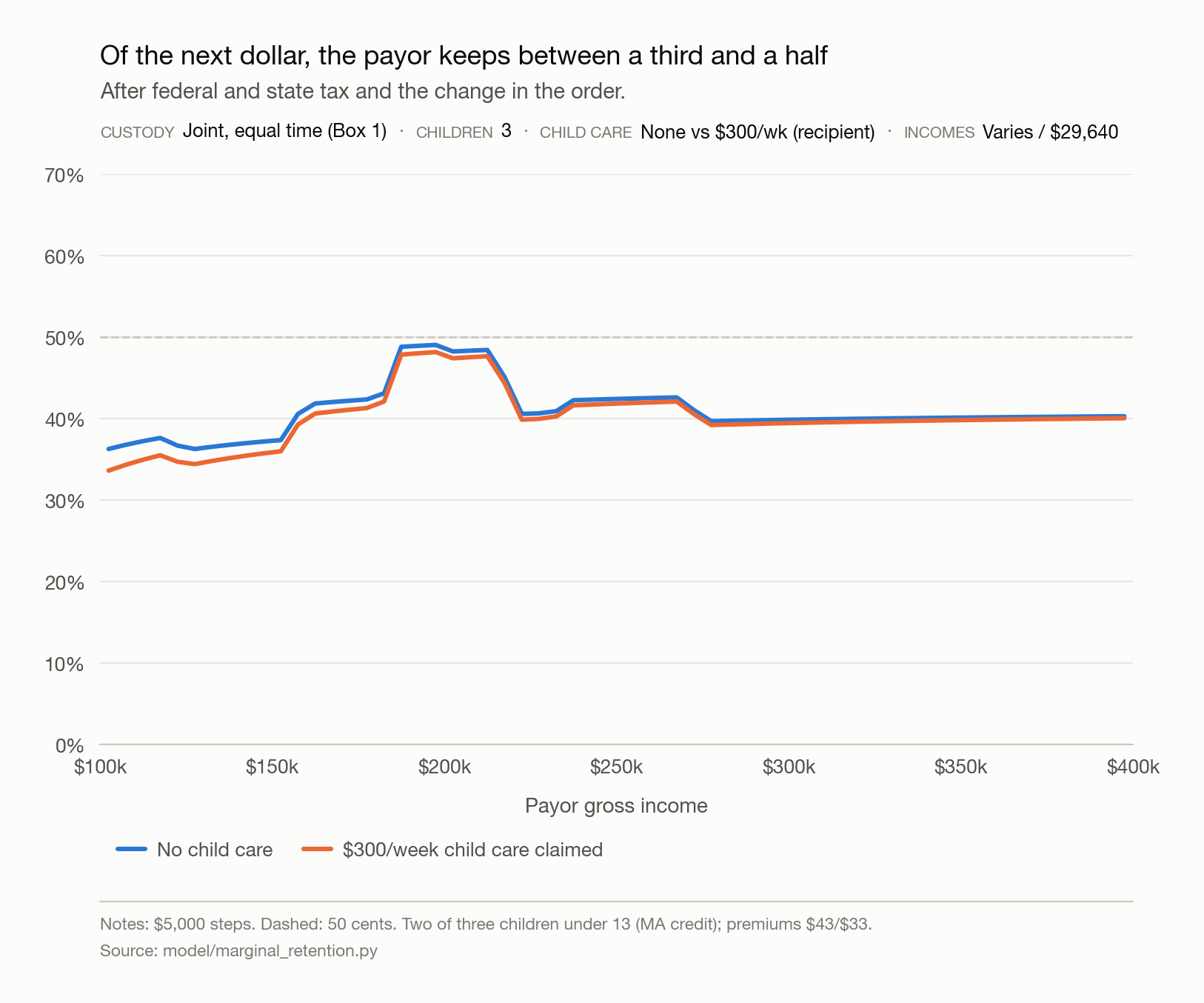
Of the payor's next dollar, the payor keeps between a third and a half.
Marginal retention after federal and state tax and the change in the order.
The order's marginal take runs near 20 percent, above Table A's 10 percent top bracket, because the child-count multiplier and the rising income share both scale with the payor's income. $5,000 steps. Dashed line: 50 cents. Two of three children under 13 (MA credit); premiums $43/$33.
Source: model/charts/fig4_retention.py · model/marginal_retention.py ·
data (CSV)
7. Challenging the order can cost more than it saves, so wrong orders go uncontested
The deviation rate is the Commonwealth's own figure. How often a contested deviation succeeds is not published.
Federal law requires the guidelines amount to carry a rebuttable presumption. Massachusetts’s own guidelines make rebutting it conditional on a judge making four specific findings: the guidelines amount, that applying it would be unjust or inappropriate, the facts justifying departure, and that departure is consistent with the child’s best interest. Meeting that bar takes a lawyer, and a lawyer costs more than a child care claim or a parenting-time credit is usually worth.
So the right exists and cannot be exercised.
The Commonwealth publishes how often the presumption is rebutted. It does not publish the one number that would tell a parent whether contesting is worth it: how often a deviation motion the parties did not simply agree to still succeeds.
8. At equal parenting time, the recipient household ends up with more money than the payor in 10% of income combinations
Verified against the form's own calculation scripts
Across the three-child equal-time grid (Box 1, the Worksheet’s equal-time calculation), the recipient’s household ends up holding more money than the payor in 9.9% (114 of 1,147) of income combinations. In every one of those 114 the payor still holds more per person, because that household is supporting four people and the payor one (E01, E02).
At this site’s own worked example the payor is the one ahead, keeping $87,172 a year against the recipient household’s $77,395, which is $19,349 each for the four people in it.
Both figures take out federal and Massachusetts income tax, Social Security and Medicare, and count no refundable credits. A credit turns on which parent claims which child in a given year, which CJ-D 304 does not collect and a reader cannot reproduce from published rate tables.
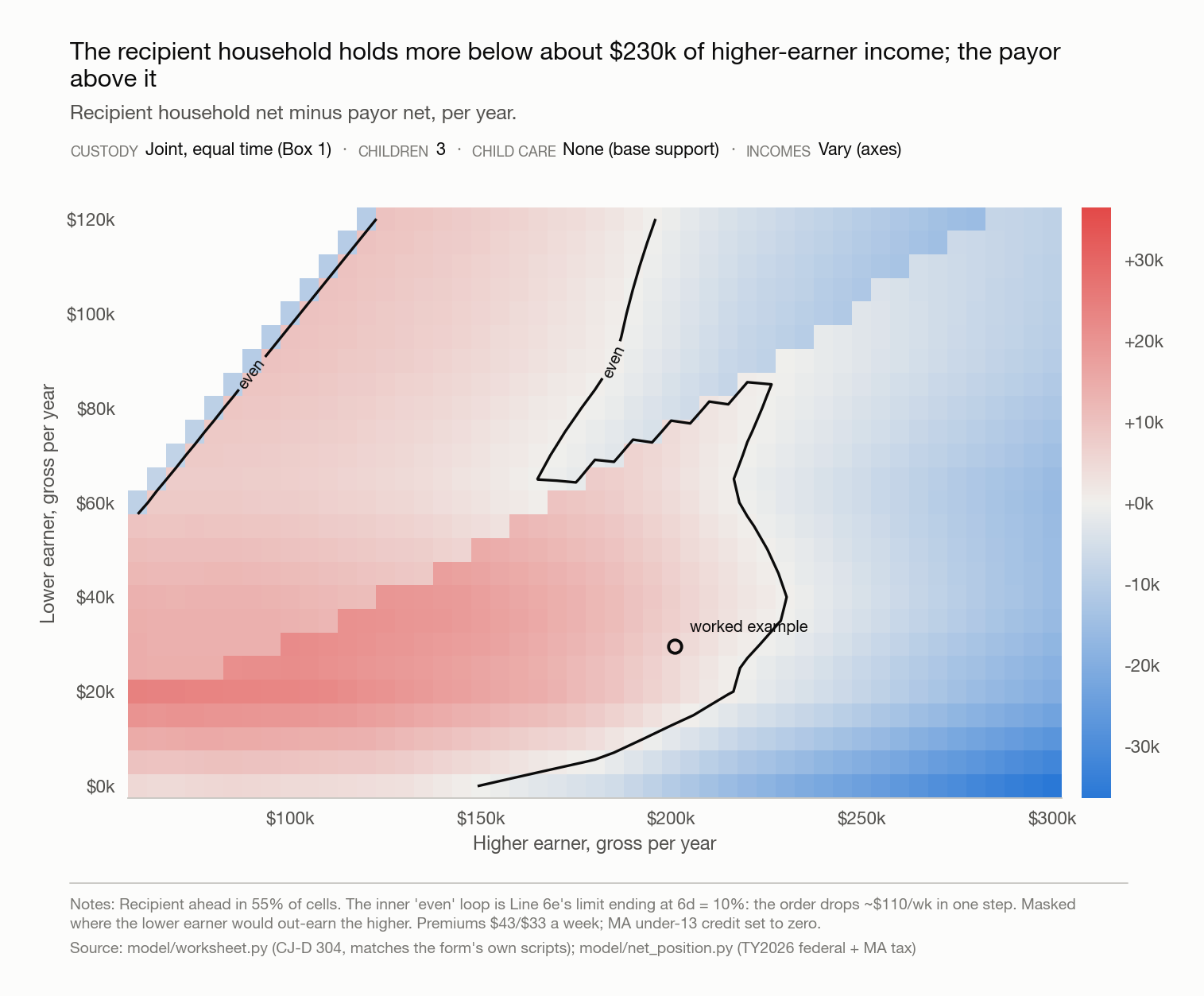
With three children, the recipient household holds more after the order in 10 percent of income combinations.
Recipient household net minus payor net, per year.
Of the 10 percent of the grid where the recipient household is ahead, 75 percent sits below $150,000 of higher-earner income, and none above $175,000. The closed contour inside the red region is Line 6e's limitation, which stops binding once the payor's Line 6d crosses 10 percent; the order then drops about $110 a week in one step. Per person the payor still leads almost everywhere (E02). Masked where the lower earner would out-earn the higher. Premiums $43/$33 a week; MA under-13 credit set to zero; no refundable tax credits counted.
Source: model/charts/fig1_heatmaps.py · model/worksheet.py · model/net_position.py ·
data (CSV)
9. After a child turns 18, support can run to 23 and goes to the other parent, even while the child is at college
Massachusetts lets a court order support until a child turns 23, G.L. c. 208, § 28, and the Appeals Court treats a student at college as still living with the parent who receives it. A parent can pay tuition, room and board and still owe support to the other parent for the same months. Federal law sets no age at which support ends and no rule on who receives it. After 18, the money should go to the child or the college.