
Federal law
The Massachusetts child support guidelines do not comply with federal law
While federal law requires every child support order to rest on the parent's ability to pay, the Massachusetts Worksheet never computes what a parent keeps after tax. With child care claimed, it sets orders above the federal withholding ceiling: amounts the Commonwealth cannot lawfully collect.
of income pairs produce an order over the federal ceiling with $100 a week of child care claimed per child (three children, primary custody)
Every income pair run through the Worksheet's own arithmetic
I pay child support in Massachusetts myself, so I have a stake in the outcome. The figures on this page are not about one family. They cover every pair of incomes the model runs through the Worksheet, with three children and the other parent holding primary custody.
Every figure here comes from model/ccpa_grid.py, which runs the Worksheet in model/worksheet.py across the whole income grid and tests each order against the federal ceiling. It is checked by model/test_ccpa_grid.py.
Federal law requires every order to rest on the parent’s ability to pay, and the Worksheet never measures it
Every state’s child support guidelines must provide that the order is based on the parent’s “earnings, income, and other evidence of ability to pay,” 45 C.F.R. § 302.56(c)(1), and meeting that rule is a condition of federal approval of the state’s child support plan, § 302.56(a). Massachusetts says it does this. The Guidelines open by reciting the federal rule almost word for word: “These guidelines are based on various considerations, including, but not limited to, each parent’s earnings, income, and other evidence of ability to pay.”
While the Guidelines recite the standard, the Worksheet that produces the number holds none of it. It has no line for net pay, after-tax income or disposable earnings, no line for tax, and the words ability to pay appear nowhere on it. A form that does not know what a parent keeps cannot base an order on what that parent is able to pay.
The federal agency that wrote the rule has already answered the objection that this is a state’s business. When commenters on the 2016 rule argued that orders were too high and discouraged shared parenting, the Department of Health and Human Services replied that a state keeps its discretion over the percentage, “so long as the resulting order takes into consideration the noncustodial parent’s ability to pay it,” 81 Fed. Reg. 93528. The discretion is real and it comes with a condition. Massachusetts has taken the discretion without meeting the condition.
With child care claimed, the Worksheet sets orders the Commonwealth cannot lawfully collect
Congress caps what may be withheld from a paycheck for child support at 50 percent of take-home pay, or 60 percent for a parent with no second family to support, 15 U.S.C. § 1673(b)(2). This site calls the 50 percent line the federal ceiling.
The Worksheet has no line for the payor’s household, so it cannot tell which of the two ceilings applies to the order it sets. That ceiling limits collection, not the order. No federal rule limits how large an order may be, so a court can order more than an employer may withhold, and the rest is still owed. The only federal rule on the order itself is the ability-to-pay requirement, and it never says what ability to pay is.
With $100 a week of child care claimed per child, well under the $430 the Guidelines allow, 40% of income pairs produce a three-child primary-custody order over the federal ceiling. At the Guidelines’ own limit of $430 a child, every pair crosses it, and at its highest the order reaches 186 percent of take-home pay, nearly twice what the parent brings home.
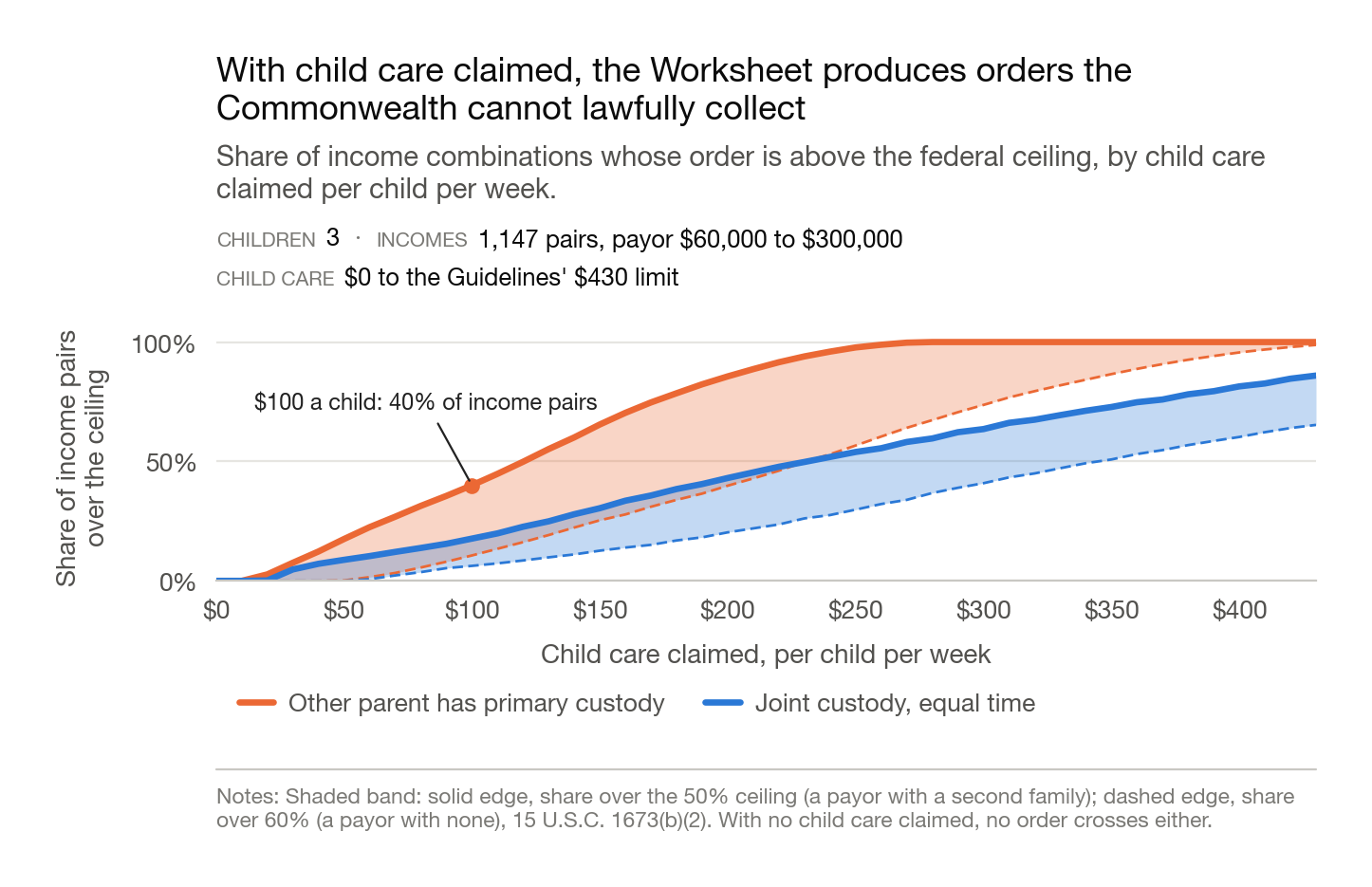
With child care claimed, the Worksheet produces orders the Commonwealth cannot lawfully collect.
Share of income pairs whose order is above the federal ceiling, by child care claimed per child per week.
Three children. Federal ceiling, 15 U.S.C. § 1673(b)(2), shown as a band: 50 percent of take-home pay for a payor with a second family, 60 percent for one without. At $100 a child, 40 percent of pairs cross the 50 percent line under primary custody.
Source: model/ccpa_grid.py ·
data (CSV)
The crossings are not a rich parent’s problem. The pairs that cross first are payors earning $60,000 to $100,000 against another parent with little or no income.
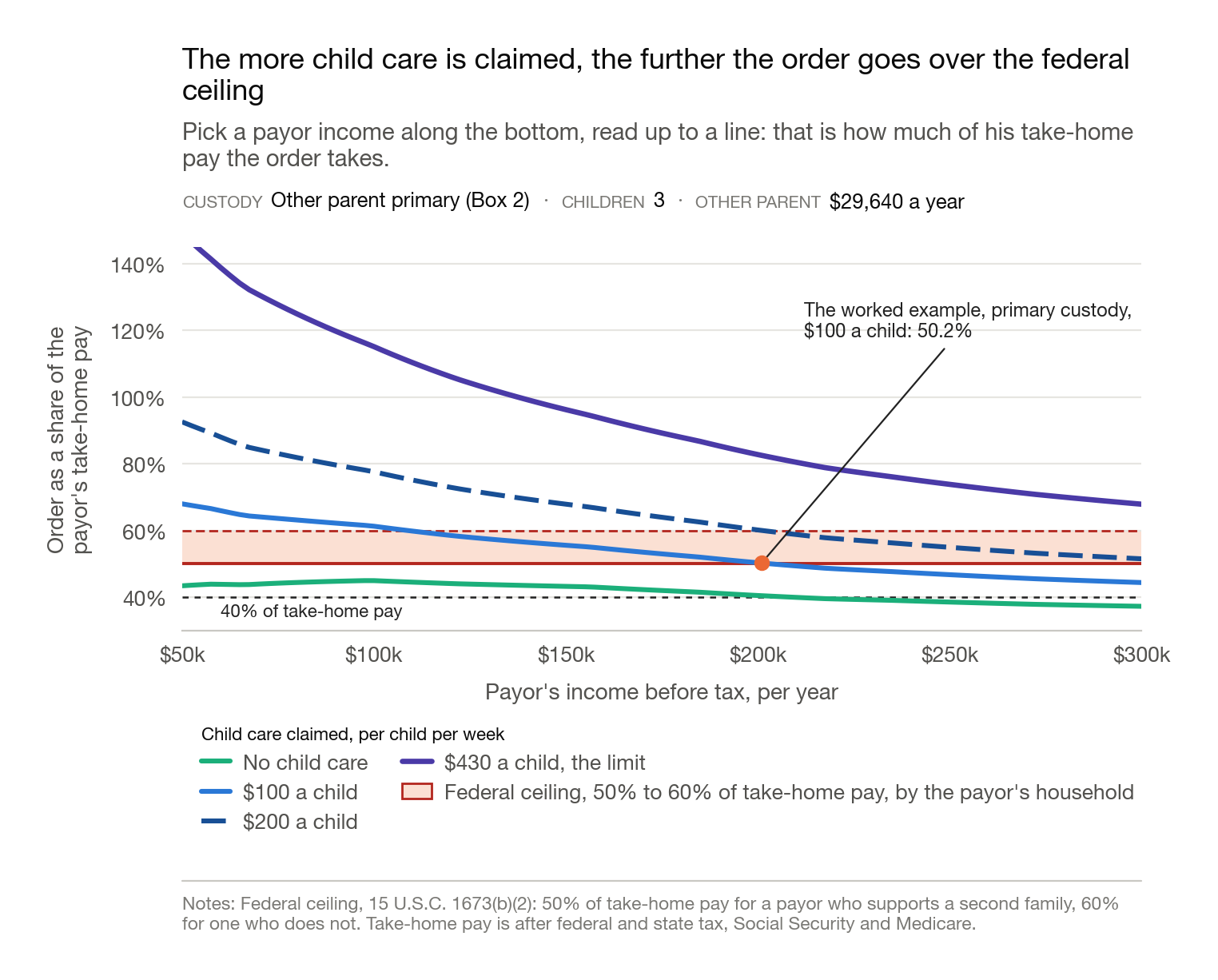
The more child care is claimed, the further the order goes over the federal ceiling.
The order as a share of the payor's take-home pay, three children, the other parent primary, the other parent earning $29,640 a year.
The shaded band is the federal ceiling: 50 percent of take-home pay for a payor with a second family, 60 percent for one without. Take-home pay is after federal and state income tax, Social Security and Medicare.
Source: model/ccpa_grid.py ·
data (CSV)
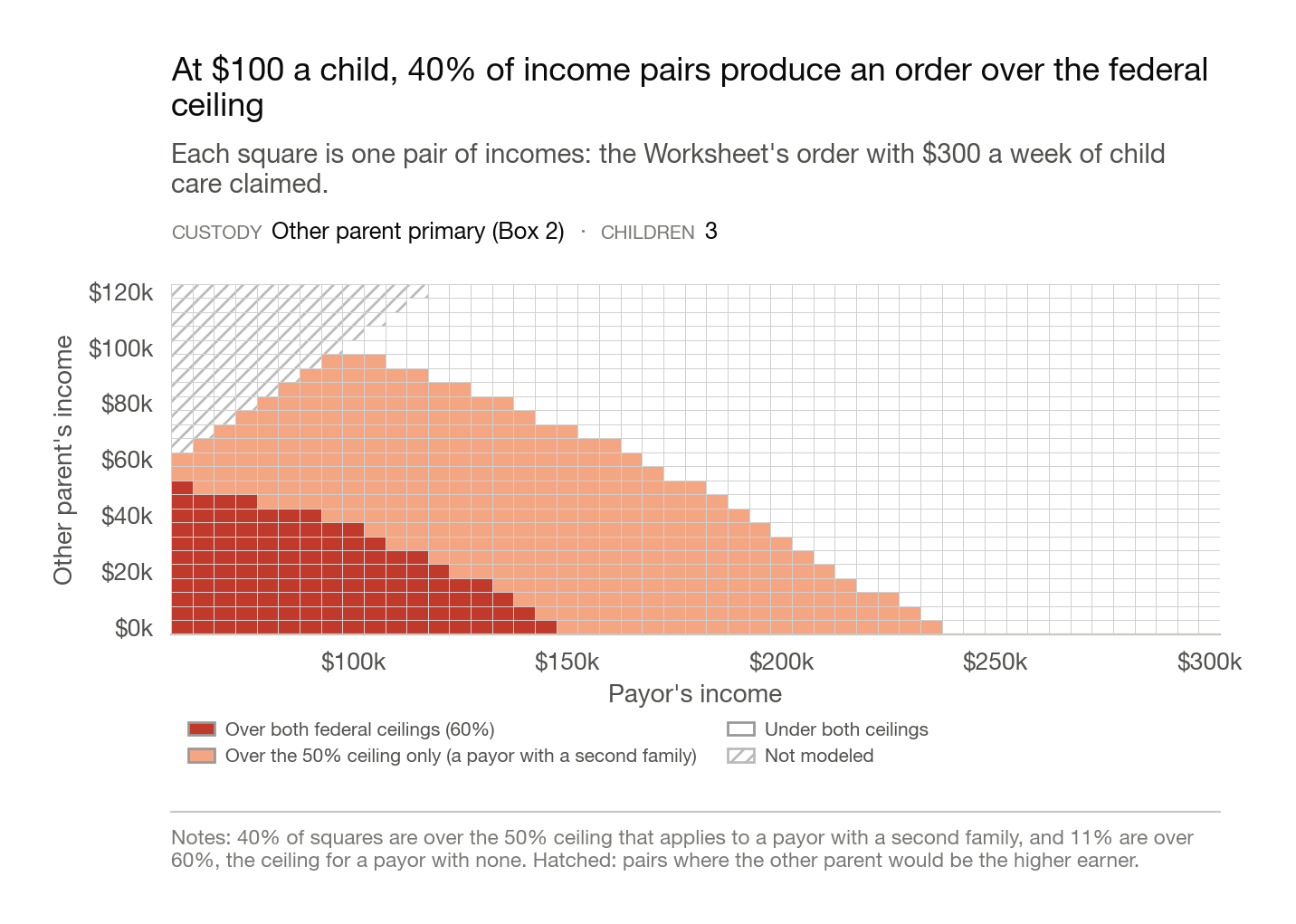
At $100 a child, 40 percent of income pairs produce an order over the federal ceiling.
Each square is one pair of incomes: the Worksheet's order with $300 a week of child care claimed for three children, primary custody.
Dark squares are over both federal ceilings (60 percent); light squares are over the 50 percent ceiling that applies to a payor with a second family. Hatched squares are pairs where the other parent would be the higher earner.
Source: model/ccpa_grid.py ·
data (CSV)
With no child care claimed, no order on the grid crosses the federal ceiling. Child care is what carries it past, and child care is inside the Guidelines: the same Worksheet adds it to the order, up to $430 a week per child. So the Guidelines themselves produce amounts the Commonwealth may not collect in full, and an amount a state may not lawfully take is not evidence of ability to pay.
Massachusetts collects the order from net pay and sets it from gross pay
The Commonwealth’s own collection statute, G.L. c. 119A § 12, cites the federal withholding ceiling three times. While the Commonwealth measures the paycheck in net pay when it takes the money, it measures it in gross pay when it decides how much to take, and the Guidelines never compute net pay at all. A state that can compute net pay to collect an order can compute it to set one.
The Guidelines’ own hardship rule shows what that costs. It presumes an order is too high once it takes 40 percent of the payor’s income, but it measures that income before tax. In the worked example it stays silent until the order is taking 56.9 percent of take-home pay. The hardship test page works through it line by line.
The fix is a federal definition of ability to pay, with a limit for primary and for joint custody
Federal law should define ability to pay as the payor’s net pay less the child care he pays himself, because both come out of the same paycheck. A presumptive order, child care included, should never take more than 40 percent of it, and never more than 25 percent in joint custody. The 40 percent is Massachusetts’s own hardship threshold, applied to the income the order is actually paid from. Federal law already requires a floor of this kind for a low earner and leaves the method to the state, § 302.56(c)(1)(ii), so a ceiling at the top is the same kind of rule.
Three jurisdictions already cap the order itself: Delaware at 50 percent of available income, Washington at 45 percent of net income, and the District of Columbia at 35 percent of adjusted gross income with child care included. No state checks the order against the federal withholding ceiling when it sets it.
Parents paying orders set under the current Guidelines should be able to ask for an immediate reduction to what the corrected rule allows, without showing any other change in circumstances. Today an order can only be reviewed back to the Guidelines, 42 U.S.C. § 666(a)(10), which for a guideline that does not comply is no review at all. The full list of changes is on the recommendations page.
Nobody has ruled on this yet, and the federal office has approved the Massachusetts plan
This is an argument from the federal rule and the Commonwealth's own documents, not a finding by any court or agency. The federal Office of Child Support Services has approved the Massachusetts plan with this Worksheet in it, and the rule does not require a worksheet line labeled ability to pay. Most states set support from gross income under approved plans, and Massachusetts's low-income adjustment meets the rule's protection at the bottom of the income range. The question is whether anything in the Massachusetts Guidelines tests the resulting order against what the parent can pay, and above the low-income range nothing does.
The federal ceiling limits what may be withheld from a paycheck, not the size of the order a court may enter, which is how the Worksheet can set an amount above it. The part of that order above the ceiling cannot be withheld from the parent's pay.
Check it yourself
Every number on this page is computed, not typed.
model/ccpa_grid.pyRuns the Worksheet over every income pair at each child care level and counts the orders over the federal ceiling.model/test_ccpa_grid.pyPins the counts on this page, including that no order crosses any ceiling with no child care claimed.model/net_caps.pyThe take-home pay calculation and the 40 and 25 percent ceilings.- fig_ceiling_grid.csv Every income pair behind the grid chart, with its order and share of take-home pay.